1. The actual volume density of your mine differs from the average values
• "Pumis" generally has low (intrinsic) interior density, but any specific mine can be different. Some pumice is less porous and their density is close to Scoria.
2. Moisture and surface water / absorbed
• The shell can absorb a lot of water due to pores. If the shell is wet or wet before the load, the weight of each cubic meter will increase. Drivers feel weight, not volume.
3. The amount of impurities and heavy stone materials (zigzers, clay, mixed rocks)
• If inside the shells the amount of impurities (soil, clay components or dense stone), the volume weight increases.
4. Packaging and density during loading (Compaction / Settling)
• The shell with a smaller or fine -grained (finean) shell sinks together and the air space stays less, thus weighing more per cubic meter. Loading by repeated drainage or banging also increases the density.
5. Different granulation between mines
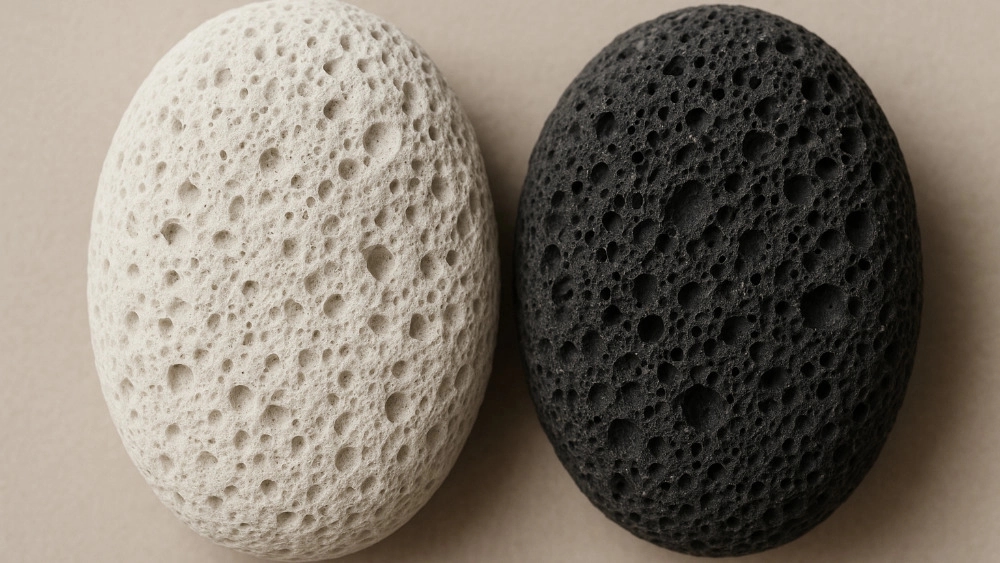
• If the white shell is mainly smaller, the space between the less particles and the volume (Bulk Density) becomes greater than the coarse -grained black shell (which has more space between the parts).
6. Price unit misunderstanding (price in cubic meters of VS tone)
• If you pay the price on a cubic meter but the trucks are renting in tone, the driver will take the real weight and if your product is less volume but more mass, they will be unhappy.
number and example (a few reference numbers to imagine better)
• Professor of the Sample: If Bulk Density (Solid, Loose) = 400 kg/m³ → 1 m³ ≈ 0.4 TON.
• If Bulk density = 1,000 kg/m³ → 1 m³ ≈ 1.0 TON.
So the same "one cubic meter" of the sheet can weigh between 0.4 and 1.2 tons, depending on the mine, grain and moisture. This is the main reason for driver dissatisfaction.
What tests do to find out what really is (technical steps)
1. Determine the volume density (Bulk Density)
• Mass measurement of the number of cubic meters in "lumbe" mode and in "compacted" mode (shrinkage/vibration). Unit: kg/m³ or kg per 1 m³.
2. Moisture Content measurement
• Weigh the sample, then dry up to 105 ° C and weigh again to gain moisture percentage.
3. Sieving / Gradation Analysis
• Look what the percentage of fine and coarse -grained is more → more density → more volume weight.